DERC Newsletter
|
|
|
No. 49 Spring / Summer 2003
|
|
|
|
In this issue:
|
|
Thank You
Thank you to everyone who has sent in their records from 2002. Some of the
highlights are mentioned below. This year work begins in earnest on the Rare Plant
Register, and there is a call from John Hunnisett for more bug records, so please
continue to send your records in.
Before Christmas I attended a very interesting workshop which looked at some of
the legal matters relating to biological data. At DERC we have always taken the view
that people who send records in to us are doing so on the understanding that this
information may be made available to others as and when appropriate, and that recorders
have trusted DERC staff to make these judgements (with the aid of our management panel
and other experts).
However, much of this meeting (which covered human rights, data protection and
copyright issues) concerned active rather than passive agreement. Hence
we are currently revising our data release and data exchange forms to cover some of the
issues raised. We are also working on a document which will set out our data access
policy and bring DERC in-line with guidance from the National Biodiversity Network.
The DERC website already outlines the possible users of data held at DERC, and this
seems the ideal place to lodge a copy of the policy plus any similar documentation. In
the meantime if you have any thoughts on the issue, I would be pleased to hear from you.
Carolyn Steele (Record Centre Manager)
|
Dorset Rare Plant Register
Early spider-orchids
Photo: Bryan Edwards |
During 2003 we hope to complete a register of all of Dorset’s rare plants, showing
the sites recorded since 1990. Thanks to the records already held by DERC and the
Botanical Society of the British Isles, including those from Dr Bowen, we have a
fairly good base. However, we need more information and there are two major ways
that people could help:
- Firstly, we now have a list of plants with no recent records. Please contact
DERC for more details.
- Secondly, to all recorders, the following 10 species are rare in Britain but
so relatively common in Dorset that most people do not bother specifically to record
them.
| Species |
Area of Interest |
| Early Spider-orchid (Ophrys sphegodes) |
Purbeck |
| Dorset Heath (Erica ciliaris) |
all of range |
| Wild Cabbage (Brassica oleracea var. oleracea) |
all records, particularly Kimmeridge to Durlston |
| Portland Spurge (Euphorbia portlandica) |
White Nothe to Gad Cliff |
| Golden-samphire (Inula crithmoides) |
all of range |
| Golden-samphire (Inula crithmoides) |
all records, especially Portland |
| Yellow Vetchling (Lathyrus aphaca) |
any records outside Portland |
| Ivy Broomrape (Orobanche hederae) |
any records outside Portland |
We intend to publish distribution maps of these species in the Rare Plant Register,
rather than detailed texts, but many species have big gaps for post 1990 records. The
current distribution maps, showing recent records, are
here but we need to fill in the gaps. Please help us by sending any records for these
species directly to DERC (don’t wait for your end of year submission).
David Pearman
Top |
DERC Summer Workshops
Please book in advance leaving a contact number. Alterations to the programme may be
necessary, and places are limited. More details will be sent out nearer the time.
Acid Grassland NVC
at Corfe Common
Thursday 5th June with Bryan Edwards (£20)
Invertebrates Day
at Melbury Park
Friday June 27th with John Hunnisett and Phil Sterling (£5)
Bat Evening
at Kingston Maurward College
Wednesday 16th July at 7 pm, with John Stobart (English Nature) and
Imogen Davenport (DWT) (£5)
Dormice & Small Mammals
at The Barn, Kingcombe Centre
Saturday 13th September with John Stobart (EN) and Sue Eden (£5)
Top |
Spiders in the home
|
Pholcus phalangiodes
Drawing: Robin Walls |
|

Scytodes thoracica
Drawing: Robin Wall |
It’s a well-known fact that we share our houses with spiders. The so called House Spider
Tegenaria saeva is regularly seen in autumn when running at high speed across the
floor or perhaps when it is stuck in the bath, but others are not so obtrusive. There are
two in particular that we would like to hear about, if you have them in your house.
Pholcus phalangioides is a spider that weaves a loose web in the corners of rooms.
It is unmistakable in that it has very long legs and a cylindrical body about 10 mm long,
but the most obvious characteristic is its habit of shaking and whirling its body at high
speed when approached. It is possibly quite common in houses in southern England but vastly
under-recorded.
The second is a much rarer spider that captures its prey by spitting a mixture of glue
and poison at them. Scytodes thoracica is a much smaller spider, about 6 mm long
but its markings and shape are very characteristic (see sketch). The only Dorset records
for the latter species come from homes of arachnologists, surely this is too much of a
coincidence.
John Hunnisett.
Top |
New finds in 2002...
|

Hawthorn shield bug
Photo: Kevin Cook |
Dorset lays claim to having records for 471 of the 656 species of spider at present on the British list. Therefore finding a new species in Dorset is an unusual event. In June of last year Ian Pembroke swept a Salticid (Jumping Spider) from ground covering ivy on the east side of Portland. He identified it as
Bianor aurocintus, a spider that has mainly been recorded from the south-eastern part of England. This record now constitutes the most south-westerly location for this
spider.
Whilst carrying out a survey of chalk downland in Dorset, two species of Hemiptera worthy of note have been found. The plant hopper
Ribautodelphax imitans was found by suction trapping on the southern slopes of Bincombe Hill in August. This record constitutes the fifth location in the British Isles, the others being in Sussex, Devon and Portland (Dorset).
A second site in Dorset has been found for the RDB 3 mirid bug
Hallodapus montandoni. It was discovered whilst surveying one of the sparsely covered slopes of Maiden Castle. The other location in Dorset is Hod
Hill.
...and plans for 2003
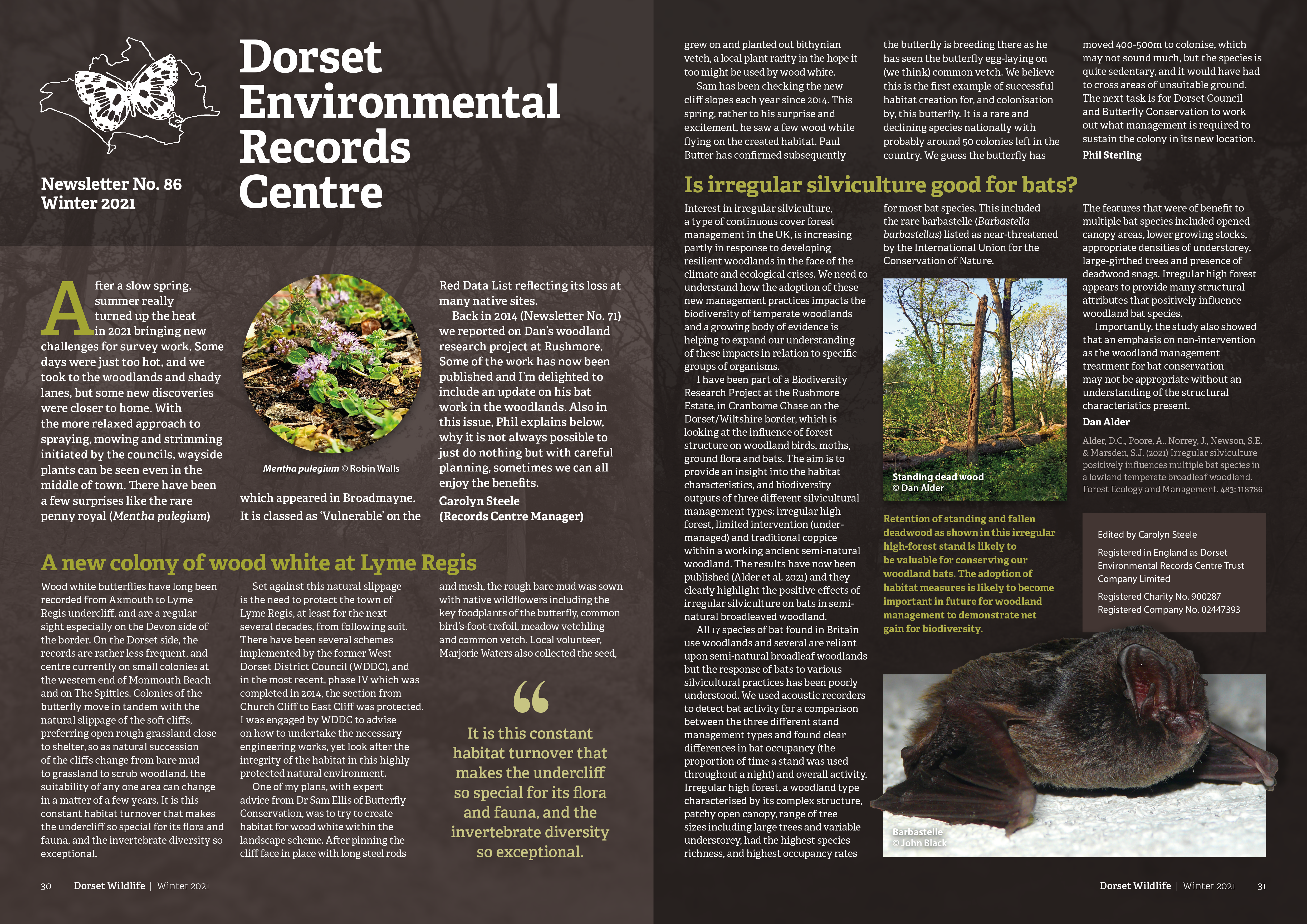
Unlike some of the more popular insects, there has never been a comprehensive review of the Heteroptera of Dorset, a situation that hopefully will be dealt with in the near future. The Heteroptera have mouthparts adapted into a syringe-like tube for sucking sap or blood. Some of their more common names are shield bugs, pond skaters and water boatmen. We would like to produce a booklet on Heteroptera but they have been very under-recorded in Dorset. If anyone has Heteroptera records not submitted to DERC or is interested in the study of this group of insects we would like to hear from you.
John Hunnisett
Top
|
|