Geological Conservation In Dorset
|
|
|
|
|
Dorset's Important Geological Sites Group
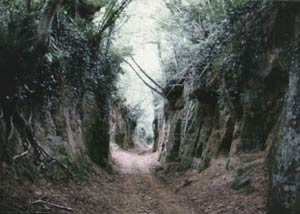
Quarr Lane open space, Sherborne
|
DERC holds about 800 records of sites of geological interest in Dorset. The
records are a combination of literature search and fieldwork. There
are over 40 SSSI's, including the whole coastline, and over 60 Regionally
Important Geological Sites (RIGS) that are mostly inland.
The primary task of the Dorset's Important Geological Sites (DIGS)
group has been to select sites for conservation. The sites were visited
by a group of members for assessment as possible RIGS using the following
criteria:
- scientific importance
- educational value
- ease of access
- historic significance
Ownership of the site is determined together with the local contacts
if neccessary. Then, only with the owner's permission, the site can
be nominated for designation. With a map and description, RIGS are
incorporated in the District Local Plans alongside SNCI's.
Thorncombe sands at Shutes Lane,
Symondsbury
|
Sites will require management; in some cases the clearance of the
rock faces needs heavy machinery, in others the removal of decades of
vegetation growth. An old quarry face has been re-exposed to show the
Forest Marble at Wanderwell quarry. This RIGS is within West Dorset
District Council's Local Nature Reserve near Bockhampton. West Dorset
has also cleared the old quarry face of Inferior Oolite Rubbly Beds
in Quarr Lane open space at Sherborne (above, right). Additionally,
in the carpark and picnic site at Rockpit Farm (Maiden Newton), the old
working face has been cleared to expose the Lower Chalk - Upper Greensand
junction. All these are excellent examples of co-operation between DIGS
and the District Council. The first and third of these sites have information
boards in place, and a board is in preparation for the Sherborne site.
In Purbeck and West Dorset the National Trust has been working with DIGS to
make their RIGS sites more accessible and visible to the general public,
such as Shutes Lane, Symondsbury (above, left). Many other landowners
are equally helpful in supporting DIGS' efforts to bring the knowledge of
earth science to a wider audience.
|
|
Top
|
The Strategic Stone Study in Dorset
St Mary’s Church: Winterbourne Abbas
This 13th Century church
is built from Lower Purbeck Cypris Freestone banded with Flint.
Photo: Jo Pennell
|
The Buildings 1, 2, 5, 6 and 8: Symondsbury
Photo: Jo Pennell
This 18th Century row
of Cottages is built from Inferior Oolite, giving it the characteristic
orange colour.
|
Post Office Cottage
This 18th Century Cottage
is characteristic of all the buildings seen in Symmondsbury. The vibrant
orange stone used is an oolitic limestone known as the Inferior Oolite.
Photo: Jo Pennell
Place Mill: Christchurch
This was the monastic mill
belonging to the Priory. It has a mediaeval stone base which contains a
mixture of Purbeck Marble, Quarr stone from the Isle of Wight, Hengistbury
Ironstone and Heathstone. Above this is red brick.
Photo: Jo Pennell
|
Between September 2009 and March 2010 Dorset’s Environmental Record Centre has
been involved in the Strategic Stone Study. This project has been organised by
English Heritage and the British Geological Survey for the conservation of historic
buildings.
The wonderful collection of picturesque rural villages found in Dorset is under
a constant threat from deterioration and development. To preserve the characteristics
of these villages new building and repairs need to use the same building stone as the
original buildings. Whereas, in the past, local stone from a local quarry would have
been used the majority of building stone quarries have been closed and, since the
beginning of the 20th Century most building stone has been imported. In Dorset now,
excluding Purbeck and Portland quarrying, there are only six other active building
stone quarries remaining.
DERC’s role in this study has been to identify the stone used in a sample of
listed buildings in each village. The data has been collated through fieldwork,
any previous research and records produced over the years. The help of many local
experts in the fields of geology and history has also been invaluable. The
information has then been added to three databases, geology, buildings and quarries.
Once all information is acquired the British Geological Survey and English Heritage
will publish this information in the EBSPits freely available website.
The collection of this data is a key component in keeping the rich characteristics
of each village and conserving Dorset’s beautiful landscape and architecture.
Jo Pennell
|
|
Top
|
Contact details for Dorset's Important Geological Sites Group (DIGS):
Contact name: |
Mr Alan Holiday
Chairman of DIGS |
Postal address: |
7 Whitecross Drive,
Weymouth,
Dorset, DT4 9PA
|
Tel: |
01305 789643 |
Email: |
alanholiday@btinternet.com |
|
|
Purbeck Limestone Quarries Virtual Field Trip
DIGS have produced a CD of Powerpoint virtual field trips to Purbeck limestone
quarries in south Dorset. The CD was produced as part of the Purbeck Keystone
Project and received funding from the Heritage Lottery Fund. Copies are available
from DIGS for £5 including P&P, payable to DIGS.
|
|
Top
|