Beetle Recording in Dorset
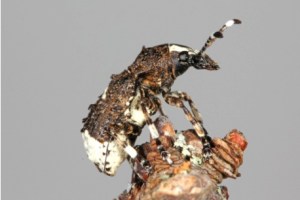
The variety of habitats in the county leads to a rich diversity of beetles in Dorset. While the lowland heaths and the coastal soft cliffs are home to a large number of national rarities, other habitats such as grasslands, wood pasture and saltmarsh hold important assemblages of species. The county also has a network of rivers and streams which, along with many lakes and ponds, are inhabited by a wide range of water beetles, some of them very rare.
In 1878 C.W. Dale published The History of Glanvilles Wootton, in the County of Dorset. This contained records of over 900 species of beetle, mainly found in the area around Glanvilles Wootton. Then in 1926, at the age of 23, E.J. Pearce published A List of the Coleoptera of Dorset containing over 2000 species. Although details of date and localities are sometimes scanty, Pearce successfully pulled together the efforts of many recorders, and he subsequently added three supplements in 1927, 1929, and 1931. Unlike Dale, who spent most of his life at Glanvilles Wootton, Pearce did not remain in the county. His 1957 Royal Entomological Society handbook on the Pselaphidae (now a subfamily of the beetle family Staphylinidae) is still much used today.

During the 1930s Captain Cyril Diver co-ordinated a thorough survey of the natural history of the Studland Peninsula. Although not himself a coleopterist his helpers recorded over 200 species of beetle on the site. From 2013 to 2015 the National Trust organised a major project to re-survey the peninsula to see what had changed in the intervening 80 years. As part of this project volunteers found nearly 800 species of beetle there.
Many beetles are very small and can only be identified by microscopic examination. There are some larger ones which the non-specialist may encounter, but even these may not be straightforward to identify, some of these are listed below.
Adrian Mylward
Large beetles and what to look for:
Carabus violaceus/problematicus These are large violet-coloured ground beetles. The close-up photograph on this identification sheet should help to distinguish them.

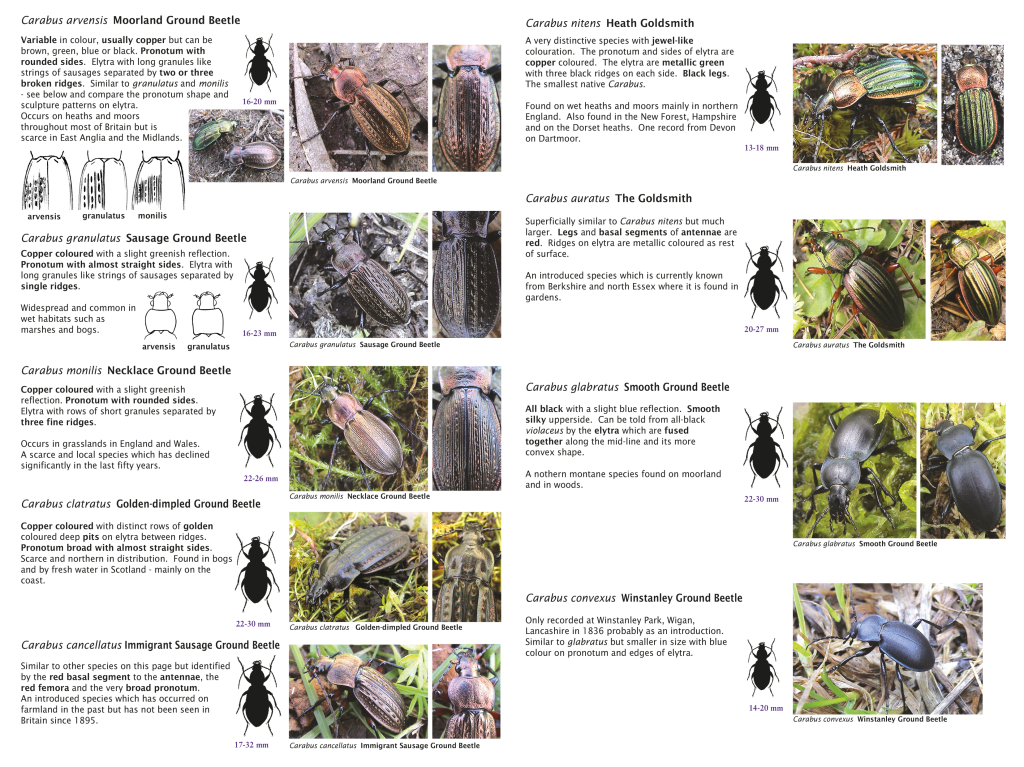

Oil Beetles Despite their common names, black oil beetle and violet oil beetle (the two most commonly encountered), cannot be identified by colour.
Timarcha tenebricosa/goettingensis These, the bloody-nosed and lesser bloody-nosed beetles, are often seen crawling on the ground. They overlap in size, but the shape of the pronotum (thorax) will distinguish them.

Contributing Your Beetle Records
Over the past 50 years there have been many surveys conducted throughout the county, generating a huge bank of data on the beetle fauna, and this is continuing. If you would like to contribute to this please visit our Sending in Your Records page. An online up-to-date list of Dorset beetles can be found here.
If you would like help with your identification you can contact me at adrianmylward@btinternet.com

