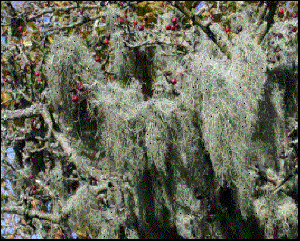
Dorset is a small lowland county that has been relatively well recorded for lichens. The earliest lichen record by William Stonestreet in 1717 is of the spectacular beard lichen Usnea articulata, for which the western part of the county is a national stronghold.
Until the 1880s there are appears to be very few recorders apart from resident naturalists such as Richard Pulteney, J.C. Dale and G. Lister. From the mid-1880s to 1906 E.M. Holmes collected many notable species from the Isle of Portland and from the Studland and Swanage area, adding new species to the county list. Many of his specimens are in Dorchester Museum. He prepared a manuscript of lichen flora for the county but it was never published.
There followed a lull in activity until the late 1950s when Dr Humphry Bowen began recording in the county. Shortly afterwards Mr Peter James from the Natural History Museum and Dr Francis Rose started surveying a number of parkland and woodland sites including the internationally important Melbury Park. In 1976 Humphry Bowen published the first modern lichen flora and listed 497 species. By the time he published the Flora of Dorset in 2001 the number of species had increased to 658. The current total for the county is 710, 38% of the UK flora, of which 20 are presumed to be extinct and 6 are dubious or erroneous records.
The Lichen Flora
The lichen flora is very diverse for a lowland county, which can in part be explained by the low levels of atmospheric pollution and the very wide variety of habitats present. However, the lack of upland areas, hard acid rock outcrops and the relatively low rainfall means than more western counties such as Cornwall and Devon support many species not found here.

Those habitats in Dorset that are important for lichens include:
- Ancient woodland
- Ancient parkland
- Wayside trees
- Lowland heathland
- Limestone rocks and soil
- Chalk grassland
- Soft cliffs
- Coastal rocks
- Sarsen stones
- Churchyards
Changes in the Lichen Flora

Lichen are quite rightly thought of as slow growing organisms requiring stable or ancient habitats. However, over the past decade there have been very dynamic changes in the lichen flora of the county and of southern England generally. Although the precise factors are not fully understood, declining sulphur dioxide levels, an increase in ammonia and nitrogen pollution and climate change are all thought to be playing a part. Recently described nitrogen-demanding species such as Bacidia adastra and Lecanora barkmaniana have been found in the county, and species thought to be uncommon such as Candelaria concolor, Flavoparmelia soredians and Punctelia borreri have increased significantly, probably due to increases in nitrogen levels and temperature.
There have been relatively few recent extinctions in the county, the last being Caloplaca luteoalba which was restricted to old Elm trees and was last seen in 1975. However, there are a significant number of species that are restricted to just one or two sites and require careful monitoring.
Contact
If you would like to send in your lichen records, or for further information on how you can become involved, please contact:
Bryan Edwards, derc@dorsetcouncil.gov.uk 01305 228520
 Dorset Environmental Records Centre