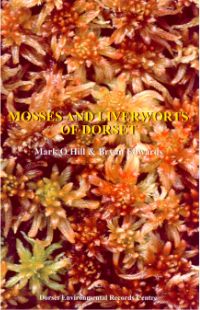
Mosses and Bryophytes
|
|
|
On this page
|
|
Resources
|
Bryophytes in Dorset
Number of mosses and liverworts
found in 10 km squares in Dorset
|
Dorset is a small lowland county with a generally unremarkable bryophyte flora,
which at present comprises 103 liverworts and 355 mosses. The number of species
is limited by the low rainfall and lack of extensive hard acid rock outcrops
compared with more western counties. However, the county was never subjected
to high levels of sulphur dioxide pollution and epiphytes are generally well-
represented, especially Leptodon smithii (Prince of Wales Feather-moss)
which is more abundant here than anywhere else in the country.
|
|
Top
|
Bryophyte Habitats
Sphagnum pulchrum Golden Bog-moss
Locally abundant in many valley mires in Purbeck,
colouring the mire surface orange.
Photo: Bryan Edwards
|
Habitats of particular importance for bryophytes in the county include the
many valley mires scattered throughout the Poole Basin. These retain a good
variety of Sphagna (bog-mosses) including the rare and beautiful
Sphagnum pulchrum (Golden Bog-moss), which dominates many of the Purbeck
mires but is not known anywhere else in southern England. Among the Sphagna a
full range of ‘bog hepatics’ (liverworts) are present.
Eurhynchium meridionale Portland Feather-moss
Photo: Bryan Edwards
|
The Isle of Portland is a nationally important site for bryophytes and has had
a long history of exploration since the discovery of Eurhynchium meridionale
(Portland Feather-moss) in 1881. The island supports many mediterranean species
at or near the northern limit of their natural habitat in Britain, including the
largest UK populations of the minute liverworts Cephaloziella baumgartneri
(Chalk Threadwort) and Southbya nigrella (Blackwort) and the moss
Eurhynchium meridionale (Portland Feather-moss) which is confined in
UK
to Dorset.
|
|
Top
|
Latest News
Plagiochila killarniensis Killarney Featherwort
Photo: Bryan Edwards
|
The flora published in 2003 had contained a few gaps in coverage, notable in the east and the north-west of the county, also some habitats such as river corridors were under-recorded in recent years. The riparian specialist
Orthotrichum sprucei Spruce’s Bristle-moss was last recorded in the County in 1984, and was discovered in 2005 on the silty bases of riverside Alder and Maple trees near Stour Provost. Since then it has turned up in a number of new localities along the Stour. Hedgerows and their associated banks are also an under-worked habitat. West Dorset in particular has some wonderful hedge banks or deeply cut into the underlying geology of Bridport Sands and Inferior Oolite. The large thalloid liverwort
Reboulia hemisphaerica Hemisphaeric Liverwort was found on a bank near Loscombe, the first record in this area since 1969.
New species to the county are few and far between these days and it is difficult to predict which moss or liverwort may turn up. With milder winters and species such as
Cololejeunea minutissima and Ulota phyllantha apparently responding to the changing climate and moving inland, and you would favour an arrival from the south. It was a great surprise when the mainly northern
Sphagnum fuscum Tawny Bog-moss was found in a valley bog in Wareham Forest. This distinctive Sphagnum forms tight hummocks of a rich brown colour and is normally found over deep peat in blanket or raised bogs in the north and west of Britain. Its next nearest site in Britain is Cors Fochno NNR just north of Aberystwyth in west Wales. There is a healthy population of 50+ hummocks in the Dorset site, some of a considerable size.
For those interesting in learning more about bryophytes in this area a Wessex Bryophyte Group has recently been formed. It will cover Dorset, Somerset and Wiltshire, and beginners and more experienced bryologists are welcome. Details of meetings can be found on the
British Bryological Society website.
|
|
Top
|
Who To Contact
If you would like to send in any records of mosses and liverworts, or for further
information on how you can become involved, please contact:
| British Bryological Society recorder for Dorset: |
Bryan Edwards |
| E-mail: |
Enquiries@derc.org.uk |
| Telephone: |
01305 228520 |
|
|
Top
|